Ch. I - Sporting CP
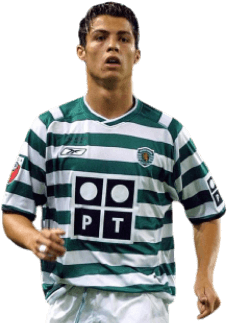
‣ At age 16, Ronaldo was promoted from Sporting's youth team
‣ subsequently became the first player to play for the club's under-16, under-17 and under-18 teams, the B team, and the first team, all within a single season
‣ A year later, on 7 October 2002, Ronaldo made his debut in the Primeira Liga, against Moreirense, and scored two goals in their 3–0 win
‣ Manchester United players urged Ferguson to sign him, after Sporting defeated United 3–1 at the inauguration of the Estádio José Alvalade in August 2003
‣ After the game, Ferguson agreed to pay Sporting £12.24 million, made him, at the time, the most expensive teenager in English football history, for what he considered to be "one of the most exciting young players" he had ever seen.
‣ In April 2013, Sporting honoured Ronaldo by selecting him to become their 100,000th member
Ch. II - Man United
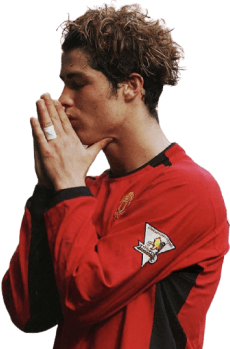
‣ Cristiano Ronaldo exhausted all superlatives during his six years with United, while he matured from an inexperienced, young winger in 2003 into officially the best footballer on the planet in 2009
‣ Made his debut in the Premier League in a 4–0 home victory over Bolton Wanderers on 16 August 2003, receiving a standing ovation when he came on as a substitute
‣ His performance earned praise from George Best, who hailed it as "undoubtedly the most exciting debut" he had ever seen
‣ Became the first player to win all four main PFA and FWA honours in a single season (2007-08)
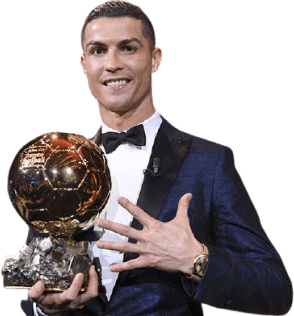
‣ Became United's first Ballon d'Or winner since George Best in 1968
‣ Scored a total of 42 Goals in all competitions during the 2007–08 season, his most prolific campaign during his time in England
‣ His goal in the second leg against Porto, a 40-yard strike, earned him the inaugural FIFA Puskás Award
‣ Final goal for Manchester United came on 10 May 2009 with a free kick in the Manchester derby at Old Trafford
Ch. III - Real Madrid
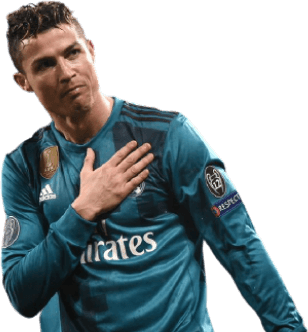
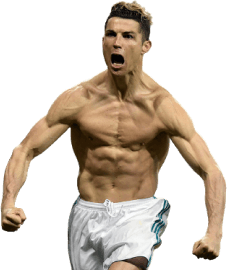
‣ Ahead of the 2009–10 season, Ronaldo joined Real Madrid for a world record transfer fee at the time, of £80 million (€94 million)
‣ At least 80,000 fans attended his presentation at the Santiago Bernabéu, surpassing the 25-year record of 75,000 fans who had welcomed Maradona at Napoli
‣ Made his debut in La Liga on 29 August 2009, against Deportivo La Coruña, and scored from the penalty spot in Madrid's 3–2 home win, scoring then in the first four league fixtures with the club, the first Madrid player to do so
‣ Scored the match-winning goal in the 103rd minute of the Copa del Rey final against Barca, winning his first trophy in Spain
‣ Ronaldo captained Real Madrid for the first time in an official match, scoring a brace to lift 10-man Madrid to a 4–3 victory over Real Sociedad on 6 Jan, 2013
‣ Scored the match-winning goal in a 2–1 victory at Old Trafford, his first return to his former home ground.
‣ He netted 451 times in 438 competitive appearances with Real Madrid (averaging over a goal a game)
‣ During the course of his nine seasons as a Real Madrid player, Ronaldo secured a number of impressive records: the club's all-time leading goalscorer, the leading marksmen in European Cup history (he scored 105 goals for Real Madrid in the Champions League); the all-time leading madridista goalscorer in LaLiga (312); highest number of games in which a player has scored three or more times in LaLiga history (34); and the most goals to have been scored by a Real Madrid player in a single season (61)
‣ During his time at the club, he also clinched the record for the most goals scored in a Champions League campaign (17) and ended the competition as the leading goalscorer on six occasions
‣ In the final of the 2018’s UCL, Real Madrid defeated Liverpool 3–1, winning Ronaldo his fifth Champions League title, 3rd in a row, and the first player to win the trophy five times. He finished as the top scorer of the tournament for the sixth consecutive season, ending the campaign with 15 goals. After the final, Ronaldo referred to his time with the Champions League winners in the past tense, sparking speculation that he could leave
Ch. IV - Juventus
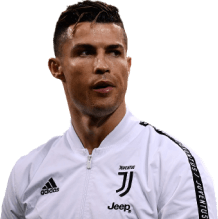
‣ Ronaldo signed a four-year contract with Italian club Juventus after completing a €100 million transfer, which included an additional €12 million in other fees, the highest ever transfer for a player over 30 years old, and the highest paid by an Italian club
‣ On 16 September, Ronaldo scored his first goals for Juventus in his fourth appearance for the club in a 2–1 home win over Sassuolo in Serie A
‣ Became the first Juventus player since John Charles in 1957 to score 10 goals in his first 14 league games for the club
‣ Won his first trophy with the club in January 2019, the 2018 Supercoppa Italiana, after he scored the game-winning and only goal from a header against A.C. Milan
‣ Finishing his first Serie A campaign with 21 goals and 8 assists, Ronaldo won the inaugural Serie A Award for Most Valuable Player
‣ On 18 December, Ronaldo performed an athletic feet, in leaping to a height of 8.39 ft (2.56m) – higher than the crossbar (8 ft) – before heading the winning goal in a 2–1 away win for Juve against Sampdoria in Serie A
‣ Finished his second Serie A campaign with a total of 31 goals and 6 assists, becoming just the third player in Juventus's history to score (30+) in a single season, and the oldest player (35 years and 166 days) to do so in one of the five top European leagues since Ronnie Rooke with Arsenal in 1948 played his 100th match in all competitions for Juventus on 13 December, scoring two penalties in a 3–1 away win to Genoa in the league
International career
‣ Began his international career with Portugal under-15 in 2001. During his international youth career, he’d represent the U-15, U-17, U-20, U-21, and U-23 national sides, amassing 34 youth caps and scoring 18 goals overall
‣ At age 18, he made his first senior appearance for Portugal in a 1–0 victory over Kazakhstan on 20 August 2003
‣ Euro 2004: held in his home country, and scored his first international goal in a 2–1 group stage loss to eventual champions Greece. After converting his penalty in a shoot-out against England in the quarter-finals, he scored the opening goal in the 2–1 win over the Netherlands in the semis. Featured in the team of the tournament, having provided two assists in addition to his two goals
‣ WC 2006: scored his first WC goal against Iran with a pk in Portugal's second match of the group stage. Went on to score the vital winning penalty during the shoot-out against England, which sent Portugal into the semi-finals, but they eventually lost to France 1-0
‣ A day after his 22nd birthday, he captained Portugal for the first time in a friendly game against Brazil on 6 February 2007, then became the squad's permanent captain in July 2008
‣ Euro 2008: was given the number 7 shirt for the 1st time. While he scored 8 goals in the qualification, the 2nd highest tally, he scored just 1 goal in the tournament (2nd goal of their 3–1 win in the GS match against the Czech Republic, he also set-up Portugal's third goal in injury time, which was scored by Quaresma, and was named MOTM for his performance). Portugal were eliminated in the QFs with a 3–2 loss against eventual finalists Germany
‣ WC 2010: named MOTM in all three matches against Ivory Coast, North Korea, and Brazil, but sadly got eliminated with a 1–0 loss against eventual champions Spain in the round of 16
‣ Euro 2012: Scored twice in the last group stage game against the Netherlands, to secure a 2–1 victory. Scored a header in the quarter-final against the Czech Republic to give his team a 1–0 win. Was named MOTM in both games. Portugal were eliminated in the penalty shoot-out against Spain, after a scoreless game, but he didn’t take a penalty as he had been slated to take the unused fifth slot. As the joint top scorer with three goals, alongside five other players, he was again included in the team of the tournament
‣ A qualifying match on 17 Oct 2012, a 1–1 draw against Northern Ireland, earned him his 100th cap. His first int hat-trick also came against Northern Ireland
‣ Scored 2 in a 5–1 friendly win over Cameroon in 2014 to become Portugal's all-time top scorer
‣ WC 2014: took part in the tournament despite suffering from patellar tendinitis and a related thigh injury, potentially risking his career. His 50th international goal made him the 1st Portuguese to play and score in 3 WCs. Portugal were eliminated from the tournament at the close of the GS on GD
‣ With the only goal in another victory over Armenia on 14 November 2014, he reached 23 goals in the European Championship, including qualifying matches, to become the competition's all-time leading goalscorer.
‣ Euro 2016: With 2Gs and an assist in the last match of the GS, a 3–3 draw against Hungary, he became the 1st player to score in 4 European Championships, having made a record 17 apps in the tournament. Progressed the first KO match after Quarisma’s rebound goal from Ronaldo’s shot, then advanced past Poland on PKs, and thus he became the 1st player to participate in 3 European championship Semi-finals. Scored the opening goal and assisted a second in a 2–0 win against Wales in the SF, equaling Michel Platini as the competition's all-time top scorer with nine goals. In the final against hosts France, he was forced off after just 25 minutes following a challenge from Dimitri Payet, but Eder’s 109th minute goal meant team captain, Ronaldo would later lift the trophy in celebration of his country's first triumph in a major tournament. He was awarded the Silver Boot as the joint second-highest goalscorer, with three goals and three assists, and was named to the team of the tournament for the 3rd time in his career
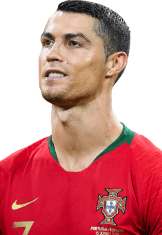
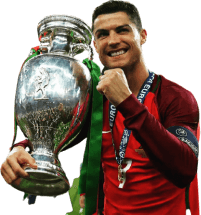
‣ FIFA Confederations Cup 2017: set-up Quaresma's opening goal in a 2–2 draw. Three days later, he scored in a 1–0 win over hosts Russia. On 24 June, he scored from a penalty in a 4–0 win over New Zealand, which saw Portugal top their group and advance to the semi-finals of the competition, and was named MOTM in all three of Portugal's group stage matches. After Chile defeated Portugal 3–0 on PKs in the semi-finals, he was allowed to return home to be with his newborn children, missing Portugal’s win against Mexico 2-1 in the third place play-off.
‣ WC 2018: became the oldest player to score a hat-trick in a World Cup match, helping Portugal secure a 3–3 draw against Spain (his third goal a 30-yard curling free kick with two minutes remaining) in their opening match, and also becaming the first Portuguese player to score a goal in four World Cups and one of four players to do so in total. On 20 June, he scored the only goal in a 1–0 victory against Morocco, breaking Ferenc Puskás’ record as the highest European goalscorer of all-time, with 85 international goals. On 30 June, Portugal were eliminated following a 2–1 defeat to Uruguay in the last 16. For his performances in the tournament, Ronaldo was later named to the 2018 FIFA World Cup Dream Team
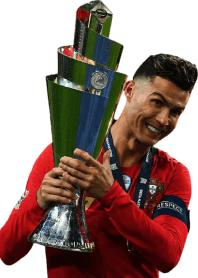
‣ Nations League Finals 2019: After missing the entire league phase of the 2018-19 UEFA Nations league, he represented hosts Portugal in the inaugural finals in June 2019, scoring a hatrick against Switzerland in the semi-final and securing a spot in the final against the Netherlands. He became the first player to score in 10 consecutive international competitions, breaking the record of nine he previously shared with Ghana's Asamoah Gyan. In the final of the tournament, Portugal defeated Netherlands 1–0, capturing his second straight major International Trophy. He later captured The "Alipay Top Scorer Trophy" given to the top scorer in the Nations League Finals with 3 goals, and The SOCAR Goal of the Tournament for his second goal against Switzerland.
‣ On 8 September 2020, Ronaldo scored his 100th and 101st international goals in a 2–0 away win over Sweden in a 2020–21 UEFA Nations League match, becoming only the second male player ever, after Ali Daei of Iran – and the first in Europe – to achieve this milestone